
I build robots, sensors, and systems that protect people. Computer engineering student, founder, and big brother from Wichita, Kansas.
03
research & invention projects
03
organizations founded or led
150+
students reached through STEM events
03
organizations founded or led
150+
students reached through STEM events
Featured Projects
Early Fire & Smoke Detection
A computer vision system that spots smoke and flames in surveillance footage before a small fire becomes a disaster.
YOLO · RT-DETR · D-Fire dataset
A drone payload that delivers first-aid supplies to flooded or remote areas and marks locations with smoke signals.
ESP32 · Cable deployment
Drone Relief & Wildfire Rescue
Air Quality Safe-Zone Monitor
An IoT device that tracks 8 environmental readings to warn woodworking workshops of fire and pollution risk.
ESP32 · 4 sensors · OLED
IoT-Based Air Quality Monitoring System
Monitor the Air. Understand the Environment.
AirWatch IoT is an Internet of Things (IoT) project designed to collect, process, and display environmental data. By integrating multiple environmental sensors with an ESP32 microcontroller, the system enables users to monitor changes in air conditions and lays the foundation for a smart, scalable environmental monitoring solution.

4
AirWatch IoT is designed to connect to Wi-Fi networks and transmit structured environmental data in JSON format to a server API through HTTP. This architecture provides a foundation for future integration with online dashboards, data storage systems, and analytical tools. Automatic data transmission requires further integration and testing before it can be considered fully operational.
IoT Connectivity and Data Integration
Key Features


3
Environmental readings are refreshed on the integrated display at an intended interval of approximately two seconds. Users can directly observe temperature, humidity, atmospheric pressure, estimated altitude, PM2.5 concentration, and the preliminary MQ135-based air quality classification.
On-Device Data Display
2
The system uses readings from the MQ135 gas sensor to classify air quality into five preliminary categories: Excellent, Good, Moderate, Poor, and Dangerous. This classification is based on predefined experimental thresholds in the program and helps users identify changes in sensor readings. The thresholds require calibration and validation before being used for health or safety assessments.
Air Quality Classification
1
AirWatch IoT integrates multiple sensors to collect environmental data, including temperature, relative humidity, atmospheric pressure, estimated altitude, and particulate matter concentrations of PM1.0, PM2.5, and PM10. By combining these measurements, the system provides a broader overview of environmental conditions in the monitored area.
Multi-Parameter Environmental Monitoring
How It Works
AirWatch IoT follows a data collection, processing, and display workflow. First, environmental sensors measure surrounding conditions and send their readings to the ESP32 microcontroller. The controller processes the collected data, performs preliminary classification of MQ135 sensor readings, and updates the on-device display. According to the system design, the data can also be packaged in JSON format and transmitted to a server through Wi-Fi and HTTP once the data transmission function has been fully integrated and tested.

Technology Stack
The system uses the ESP32 as its central controller, supported by several environmental sensors. The SHT31 measures temperature and relative humidity, the BMP280 measures atmospheric pressure, the MQ135 detects gas-related sensor signals, and the ZH03B collects particulate matter data.
The embedded software manages sensor readings, data processing, display updates, and network connectivity. Wi-Fi enables network communication, while JSON and HTTP provide the foundation for structured data exchange with a server.

Turning Engineering Ideas into Motion
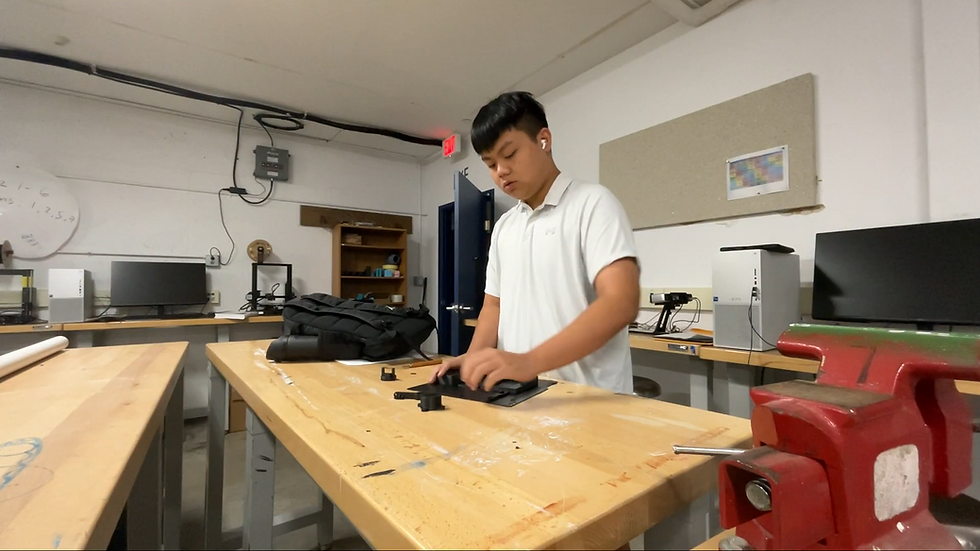
What started as an interest in robotics became a hands-on engineering project where I explored how mechanical structures, electronics, and programming could work together to create a functional robotic arm.
Through this project, I set out to transform theoretical engineering concepts into a physical system capable of controlled movement and object manipulation. From assembling the mechanical structure to exploring motor control, I gained a deeper understanding of how robotic systems are designed and built.
Key Features
01
Controlled Robotic Movement
02
Object Manipulation
One of my main goals was to understand how a robotic arm produces controlled movement. By working with its mechanical structure and motor-driven mechanisms, I explored how individual movements can be coordinated to achieve a desired position.
I explored how a robotic arm can interact with objects through a gripping mechanism. This aspect of the project introduced me to the challenges of coordinating arm movement with object handling and demonstrated the potential of robotics for simple pick-and-place tasks.
03
Hardware and Software Integration
04
Hands-On Engineering
Building the robotic arm allowed me to explore how mechanical components, electronic systems, and programming work together. I learned how software instructions can control physical mechanisms and how the integration of different components influences the behavior of the overall system.
Beyond assembling the prototype, I used the project as an opportunity to explore engineering problem-solving. Understanding how the mechanism moves, how components interact, and how the system responds to control inputs helped me develop a more practical perspective on robotics.

How I Built the System
I approached the project by breaking the robotic arm into several interconnected parts: the mechanical structure, the movement mechanism, the electronic control system, and the programming logic.
The mechanical structure provides the foundation for movement, while the motor-driven components enable the arm to change position. The control system translates input commands into movement instructions, allowing the mechanism to perform predefined actions.
By bringing these elements together, I explored the complete process of transforming a programmed instruction into physical movement.